Consumer behavior has fundamentally shifted. Digital research now precedes every dealership visit, and buyers expect transparency, personalization, and seamless omnichannel experiences. Dealerships relying on outdated marketing tactics are losing market share to competitors who understand this new reality.
Deloitte’s 2026 study surveyed 28,500 consumers across 27 markets, revealing that trust and digital-first experiences drive purchasing decisions. Torkvia helps dealership groups navigate this shift by providing the unified platform and strategic guidance needed to implement these proven marketing tactics at scale.
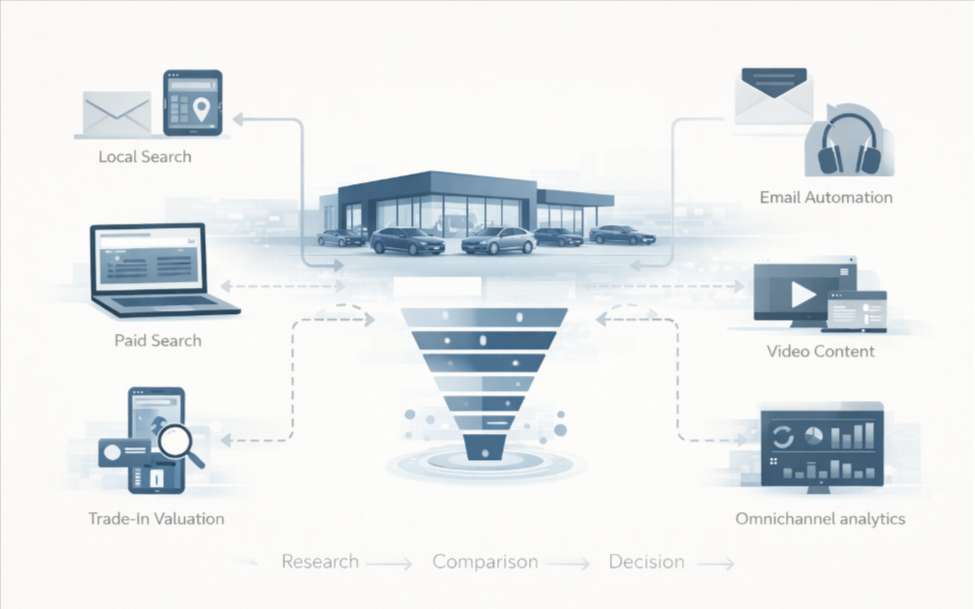
The Dealership Buyer Journey Map
Most car research happens online before buyers visit your lot.
Awareness Stage: Buyers search broad terms and need educational content.
Consideration Stage: Buyers comparison shop on third-party sites and dealership websites.
Decision Stage: Buyers need transparent pricing, trade-in valuations, and easy test-drive booking. Message differently at each stage for maximum conversion.
Why Dealership Marketing Matters
Strategic marketing directly impacts showroom traffic, service revenue, trade-in volume, and customer lifetime value. Digital advertising dominates dealership budgets, with 72% of automotive marketing spend flowing to digital channels.
The Modern Car Buyer Journey
Eighty percent of car research happens online before a dealership visit. The buyer journey spans multiple touchpoints across channels. Early-stage buyers need educational content. Mid-stage buyers respond to inventory-specific offers. Late-stage buyers need transparent pricing and local availability.
Automotive marketing trends show personalization drives engagement, video generates higher conversions, and omnichannel experiences reduce friction.
Core Marketing Strategies
Local Search & Google My Business Optimization
Complete GMB profiles with high-quality photos, regular posts, and customer reviews generate 37% more profile views and 42% more direction requests. Local search ads achieve 6.49% conversion rates—significantly higher than national campaigns. Respond to every review within 24 hours to signal active engagement and build trust with potential buyers searching your area.
Paid Search & PPC Strategy
High-intent keywords drive dealership business. Buyers searching “best auto financing near me,” “used cars [city],” and “[Vehicle] for sale [city]” are ready to convert. Allocate budget strategically: 50% to high-intent purchase keywords, 30% to mid-funnel comparison keywords, 20% to awareness-stage brand keywords. Dedicated inventory landing pages convert 15-25% higher than generic pages.
Email Marketing & Automation
Email remains automotive’s highest-ROI channel. Lifecycle automation triggered by customer behavior drives consistent engagement without manual effort. Segment your email list by buyer stage and vehicle interest. Service customer emails outperform sales emails by 10+ percentage points in opens and clicks because they provide immediate value.
Video & Content Marketing
Video generates 93% positive ROI for automotive. Create short-form vehicle walk-around videos (60-90 seconds), customer testimonials, and financing explainers. SEO benefits compound when video is embedded on your website and improves rankings for target keywords. Blog posts addressing buyer questions attract organic traffic and establish your dealership as a trusted advisor.
Trade-In Marketing Strategy: Your Biggest Revenue Opportunity
2025 Automotive Trade-In Market Report shows trade-in buyers have 3x higher lifetime value than cash buyers and are more likely to finance, return for service, and trade-in again in 3-5 years. Target service customers whose leases are ending and send automated emails offering free vehicle valuations with transparent pricing that builds confidence and drives conversions.
Omnichannel Campaign Management: The Hidden ROI Multiplier
Fragmented marketing creates fragmented results. Unified campaign management platforms track performance against dealer-specific KPIs: appointments, showroom visits, service bookings, and trade-in inquiries. Auto Dealership Industry Overview notes that modern DMS platforms integrate marketing automation, customer data, and real-time inventory—enabling precision at scale.
Dealership-Specific KPIs: Measure What Matters
Stop measuring vanity metrics. Track metrics that directly tie to revenue.
Cost-Per-Appointment: Under $25 for local search, under $40 for paid search.
Cost-Per-Showroom-Visit: Under $50.
Test-Drive-to-Sale Conversion Rate: 20-30%.
Customer Lifetime Value: 3x higher for trade-in buyers than cash buyers.
Service Department Revenue: Service represents 49% of gross profit.
Channel Performance Comparison Table
| Channel | Timeline | Cost-Per-Lead | Conversion Rate | ROI | Best For |
| Local Search & GMB | 30-60 days | $15-25 | 6.49% | Highest in first 60 days | High-intent local buyers |
| Paid Search (PPC) | 30-45 days | $35-50 | 3-4% | $3-4 per $1 spent | Qualified purchase keywords |
| Email Automation | 30-60 days | $2-5 | 12-15% | $40-44 per $1 spent | Customer retention & upsell |
| Video Marketing | 90-180 days | $1-3/view | 1.81x lift | 93% positive ROI | Consideration stage engagement |
| Content & SEO | 90-180 days | $0.50-2 | 1.57% | Highest long-term ROI | Organic traffic & brand authority |
| Trade-In Marketing | 30-60 days | $10-20 | 8-12% | 3x customer lifetime value | Service customer conversion |
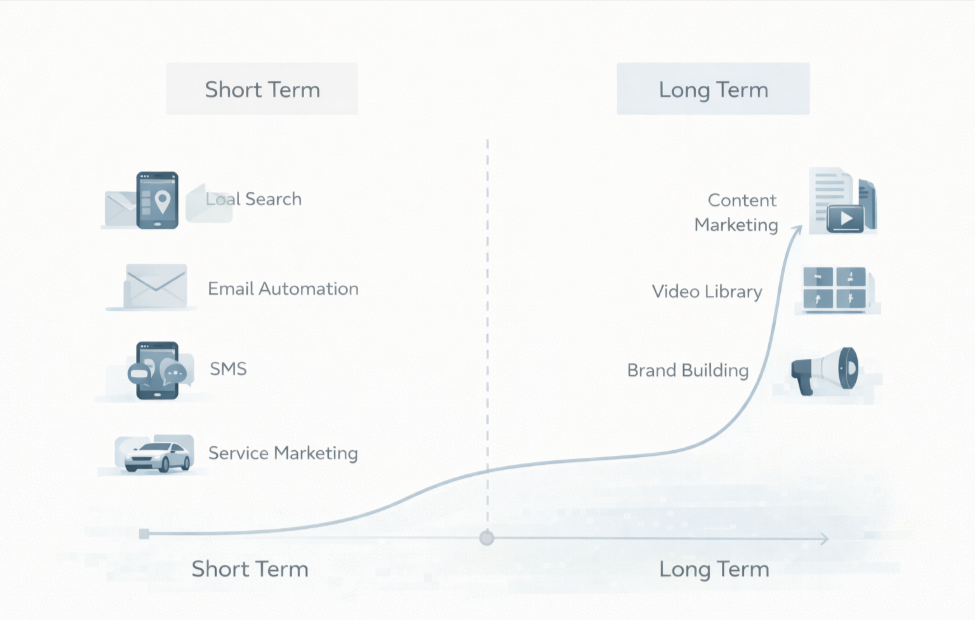
Use this table to allocate budget strategically. Quick-win channels (local search, email, trade-in) deliver 30-60 day results. Long-term channels (content, video) compound over 90-180 days. Balance both for sustainable growth.
Quick Wins vs. Long-Term Strategies
Quick Wins (30-60 Days): Local search, email automation, service department marketing.
Long-Term (90-180 Days): Content marketing, video library, brand building. Balance both for sustainable growth.
Advanced Tactics & Trends
Personalization & AI-Driven Marketing
Dynamic inventory ads show specific vehicles based on browsing history. AI-powered chatbots handle buyer questions 24/7. Customer data platforms build predictive models to identify high-conversion leads and at-risk customers.
Promotional Events & Seasonal Strategies
Slasher Sale events drive urgency. Year-end clearance taps consumer psychology. Align seasonal strategies with buyer behavior: spring (tax refunds), summer (family trips), fall (back-to-school), winter (year-end deals).
Multi-Location Dealership Groups & Marketplaces
Auto Row clusters benefit from shared marketing. Shared inventory platforms expand selection. 80% of buyers visit third-party sites like Autotrader—missing from these platforms is losing deals.
Research-Backed ROI Framework
Strategic marketing planning directly impacts profitability. Marketing of a Car Dealership Research confirms dealerships with structured marketing strategies see 15-35% improvements in sales volume and customer lifetime value.
The Attribution Blind Spot: Why Most Dealers Fail
The average car buyer touches 62 marketing channels before purchase. Most dealerships track only 1-2 touchpoints. This creates a blind spot: when dealers implement multi-touch attribution, they discover third-party sites influenced 55% of sales—not the 10% last-touch tracking showed.
SMS & Text Marketing: Quick Win Channel
SMS reaches 98% open rate within 3 hours—far outperforming email. Use text for appointment reminders, urgent trade-in valuations, service specials, and lease-end notifications. Keep messages short (under 160 characters), valuable, and opt-in only. Cost-per-message is pennies but conversion impact is substantial for time-sensitive offers.
Omnichannel Integration: The Execution Multiplier
Success requires coordination across email, paid search, local search, video, and social channels. Unified platforms eliminate silos and enable precision at scale. Know which touchpoints drive showroom visits and which drive online conversions. Reallocate budget in real-time to top performers. Dealerships implementing true omnichannel strategies see 25-35% ROI improvements because they’re not wasting budget on disconnected campaigns.
Implementation Roadmap: 6-Month Action Plan
Month 1: Optimize GMB, generate 10+ reviews, launch local search ads → 20-30% showroom visits increase.
Month 2: Email automation sequences, segment list, launch trade-in campaign → 15-25% trade-in inquiries increase.
Month 3: PPC campaigns, dedicated landing pages, A/B testing → 20-40% qualified leads increase.
Month 4-6: Omnichannel integration, attribution tracking, video campaigns → 25-35% overall ROI improvement.
Torkvia: Unified Marketing Execution
The strategies above require coordination across email, paid search, local search, video, and social channels. Unified platforms enable precision at scale. Torkvia’s AI-powered platform integrates all these channels into one dashboard.
Track real-time performance against dealership-specific KPIs. Reallocate budget to top performers automatically. Dealership groups implementing unified marketing strategies see 27% increases in appointments, 26% improvements in conversion rates, and 24% lifts in repeat customer rates.
Turning Strategy Into Results
Car dealership marketing has fundamentally changed. Digital-first buyers expect transparency, personalization, and seamless experiences. Dealerships adapting to this reality win, while those clinging to outdated tactics lose.
The proven playbook: local search, paid search, email automation, video, trade-in marketing, and omnichannel management. Competition is fierce and buyers switch brands at record rates. The dealerships winning today are those acting now. Let’s Build Together. Contact us today to explore how our platform drives measurable results for dealership groups.
Red Flags: What NOT to Do
Siloed channels — Separate email, search, and social campaigns without attribution waste budget. Integrate into one system.
Generic messaging — Sending identical messages to all audiences underperforms. Personalize by buyer stage and vehicle interest.
Ignoring reviews — 7 in 10 buyers let online reviews affect their choice. Respond to every review within 24 hours.
Wrong metrics — Track cost-per-appointment and customer lifetime value, not impressions or clicks.
No multi-touch attribution — Last-touch tracking blinds you to which channels actually drive sales. Implement multi-touch attribution to see the full picture.
Frequently Asked Questions
How long does it take to see results from dealership marketing?
Local search and email automation show results within 30-60 days. Video and content marketing compound over 90-180 days. Younger buyers like Gen Z use AI tools early in research, meaning digital channels show engagement before in-person visits.
Should we focus on local search or national paid advertising?
Both. Local search captures high-intent buyers. National advertising builds awareness for multi-location groups. Consumer research shows car buyers frequently research online before dealership visits, making strong local search presence critical. Allocate 60-70% to local, 30-40% to broader campaigns.
What’s the best way to measure dealership marketing ROI?
Track cost-per-appointment, cost-per-showroom-visit, test-drive-to-sale conversion rate, and customer lifetime value. Email ROI benchmarks and channel-specific performance data help compare results meaningfully across channels. Use a unified platform to attribute conversions.
How should we allocate budget between email, paid search, video, and local search?
Start with 35% local search, 25% paid search, 20% email automation, and 20% video and content. Adjust based on performance data. Test different allocations to find what works for your market and customer profile.
Is email marketing still effective for car dealerships in 2026?
Absolutely. Email delivers $36-42 ROI per $1 spent—far higher than paid channels like Google Ads. Service customer emails outperform sales emails by 10+ percentage points. It remains automotive’s highest-ROI channel.
How do we compete when 53% of buyers are switching brands?
Make switching toward you easier. Nearly half of new purchases involve trade-ins, which means optimizing the trade-in experience can retain customers and reduce brand churn. Use transparent pricing, educational content, and personalized offers.
What’s the biggest mistake dealerships make with digital marketing?
Ignoring digital trends like social media influence and personalization. 45%+ of buyers use social platforms in early research, yet many dealers treat channels as silos instead of integrated systems. Use omnichannel platforms that track all touchpoints.