Most dealers treat email like a broadcast tool—batch and blast to everyone in their list once a month. Meanwhile, competitors are using email as a precision instrument. They segment audiences, automate triggers, personalize messaging, and watch customers show up at the dealership with intent already formed. Email isn’t a tactic for dealers anymore. It’s a competitive requirement.
Email delivers $36-$42 ROI while driving substantial dealership website visits. Yet most dealers leave 60-70% of email potential on the table through poor segmentation, weak copy, or inconsistent sending. Torkvia helps dealership groups build email systems that convert—using data-driven segmentation, behavioral triggers, and conversion optimization to turn your customer list into a showroom traffic machine.
Why Email Matters More Than You Think
Email has the highest ROI of any marketing channel. A customer already has your dealership in their inbox. They’ve explicitly opted in (or been contacted). Your message reaches them directly without competing against algorithm changes or ad blocking. Email drives showroom visits and test drives. The problem isn’t email’s effectiveness. It’s dealer execution.
Most dealers send generic emails to their entire list on random schedules. No segmentation. No personalization. No clear offer. Of course nobody responds. Email works when you treat it like a relationship tool, not a broadcast tool. Your customer bought a truck in 2021? Email them about truck maintenance and trade-up offers. They viewed a specific inventory vehicle last week? Email them that vehicle’s financing options and availability confirmation.
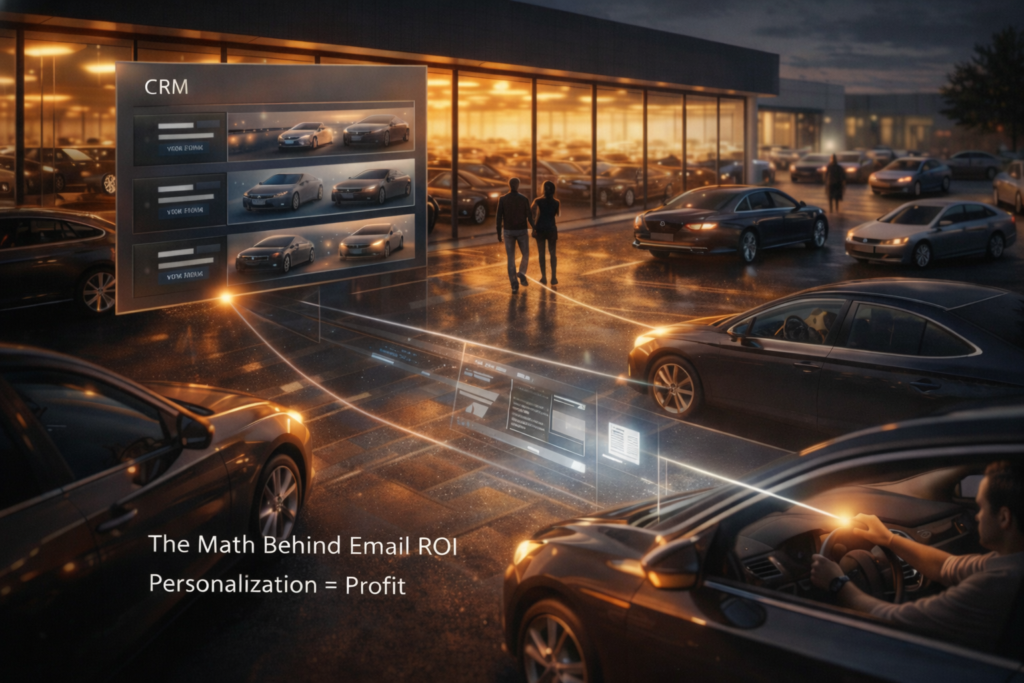
The Math Behind Email ROI
Email doesn’t just drive clicks—it drives showroom visits. While 57% of dealers send monthly emails, most see mediocre results because they don’t segment. Recent buyers, active shoppers, and lapsed customers need different messages, timing, and offers. Segmented campaigns convert significantly better, proving personalization isn’t optional—it’s profit.
Calculate email ROI simply: (Email-attributed revenue) ÷ (Email platform cost + time). Most dealers don’t track this because email isn’t connected to showroom visits or sales. Start now: tag emails with UTMs, track on-site behavior, and link campaigns to dealership visits and purchases. The results will surprise you.
Building Your Email Segments
Email only works when messages match audience. Your email list is probably 15-20 different audiences mixed together. Separate them.
Recent Buyers (Last 12 Months)
These customers should receive service reminders, maintenance tips, and accessory offers. They already know you. They already trust you. Your goal is to keep them engaged, deepen the relationship, and build loyalty for repeat service visits. Email them monthly with value-first content—not constant sales pitches.
Active Prospects (Viewed Inventory Last 30 Days)
These are the hottest leads in your list. They’re researching. They’re comparing. They’re close to deciding. Email them the specific vehicles they viewed, similar vehicles, financing offers, and test drive availability. Email them within 48 hours of their website visit. Frequency: 2-3 times per week until they respond or go cold.
Lapsed Customers (12+ Months Since Last Visit)
This segment is gold. They bought from you before. They know you. They just forgot about you. Win-back campaigns work. Email them special offers, new inventory that matches their previous purchase, and a compelling reason to come back. “It’s been a while—come see what’s new” is weaker than “Your trade-in might be worth more now.”
Service/Parts Audience
If you have service records, this is untapped potential. Customers who bought from you three years ago and haven’t serviced in two need oil changes, brakes, tires, and eventually a new vehicle. Email them service specials, maintenance reminders, and promotions tied to seasonal needs (winter tires, AC service, etc.).
Email Campaigns That Drive Showroom Visits
Service Reminders and Maintenance Triggers
These are the highest-performing email campaigns. A customer’s oil change is due in two weeks based on their service history. Send them an email with a $10 discount, a one-click appointment booking link, and a reminder of what service they need. Service reminders outperform because they’re timely and relevant. The customer was already thinking about that oil change. You just made it easy.
Inventory Match Campaigns
A prospect viewed a specific vehicle on your website but didn’t contact you. Email them that vehicle within 24 hours with clear pricing, photos, financing estimates, and a test drive button. Include 1-2 similar vehicles in case the first one was sold. These campaigns convert at 3-4x the rate of generic “check out our new inventory” emails because they’re specific.
Win-Back Campaigns
Email lapsed customers with a compelling offer. “Your previous truck just hit 50,000 miles—perfect time to think about trade-in value” or “We have three new Hondas in stock that match your previous purchase.” Include a specific offer (trade-in evaluation, upgrade discount, financing rate) with an expiration date. These campaigns work because they’re personalized and urgent.
Behavioral Trigger Campaigns
When a customer reaches certain milestones, trigger an email. Customer hit 60,000 miles? Email about transmission service. It’s been two years since purchase? Email about warranty coverage and new model comparisons. These campaigns convert because they’re based on actual customer behavior, not guesses.
Email Performance Benchmarks
Knowing what “good” looks like matters. Industry benchmarks show 12.6% average open rate and 1.2% click-through rate, but segmented and personalized campaigns beat these significantly. If your open rate is 8%, you’re underperforming. If your click-through rate is 0.5%, your copy or offers are weak. Benchmark yourself monthly. Test different subject lines. Test send times. Test offers. Even small improvements multiply across your entire list.
Track unsubscribe rate (should stay under 0.5%) and bounce rate (under 1%). High unsubscribes mean your email frequency or content quality is wrong. High bounces mean your list hygiene is poor. Clean your email list quarterly. Remove bounces. Remove unsubscribes. Segment away complainers. Your email ROI depends on sending to engaged, valid addresses.
Making Email Profitable
Email ROI compounds when you treat it as a system, not a tactic. Start with clean, segmented lists, add behavioral triggers, personalize offers, test timing and content, and review performance monthly. Even a 1% lift in open or click-through rates multiplies across your entire list.
Most dealerships send only 10–15 emails per year—severe underuse. Segmented, relevant email should run weekly or bi-weekly. Frequency isn’t the problem; relevance is. A recent truck buyer wants maintenance tips, not random inventory. Get relevance right, and frequency becomes an asset, not a liability.
Turn Email Into a Revenue Engine
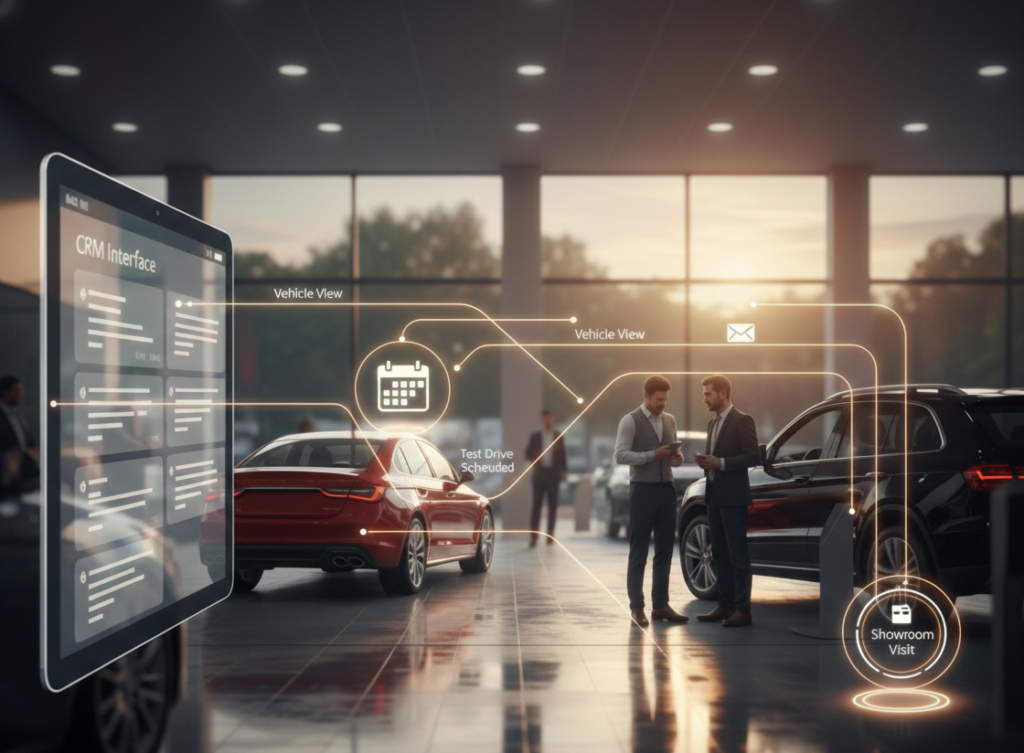
Most dealership email programs fail because they stop at sending campaigns instead of building a system. When segmentation, automation, and behavioral triggers align messages with real buyer intent, email becomes a reliable driver of showroom visits and repeat sales. The data you need is already in your CRM—the difference is how you use it.
Contact Torkvia to audit your email strategy and identify where personalization and automation can unlock immediate gains. Your customer data is already there. The question is whether it’s driving sales for you—or for your competitors.
Frequently Asked Questions
What open and click rates should I aim for?
Automotive benchmarks show 83% open rates for “We Want Your Car” campaigns and industry averages around 12.6% for general campaigns. Click-through rates average 1.2% but can reach 14% with segmentation. If your open rate is below 10%, test new subject lines and segmentation. If click rate is below 0.5%, your offers or copy are weak. Test monthly.
Does personalization really make a difference in email?
Absolutely. Personalized emails achieve 44.30% open rates versus 39.28% for generic emails—a 5% improvement from a simple change. Adding customer names, vehicle history, or purchase data significantly increases engagement. Personalization isn’t optional. It’s the foundation of email success.
Why should I segment my email lists?
Segmented and behavior-based emails achieve up to 42.36% open rates compared to generic broadcasts. When you send the right message to the right audience, engagement explodes. Recent buyers need service content. Hot prospects need financing offers. Lapsed customers need win-back incentives. One message doesn’t fit all. Segment first.
How often should I email my customer list?
Frequency depends on relevance and segment. Recent buyers and hot prospects handle 2-3 emails per week if content is valuable. Service audience triggered by maintenance needs. Lapsed customers 1-2 emails per month. Generic lists once monthly. Irrelevance is the problem—not frequency. If every email is relevant, frequency becomes an asset.
Should I invest in email automation?
Yes. Automated campaigns consistently outperform manual sends because they run continuously and improve with time. Set up workflows: purchase triggers welcome series, 60-day maintenance triggers oil change reminder, website view triggers vehicle-specific offer. Automation compounds because it works 24/7 while improving results.
How do I measure email ROI?
Track: (Revenue from email-attributed sales) ÷ (Platform cost + time) = Email ROI. Tag every email with UTM parameters so you can see traffic sources in Google Analytics. Use your CRM to track which customers received specific emails and whether they visited or purchased. Connect email sends to actual showroom visits. Most dealers don’t—start today.
What’s the biggest email mistake dealers make?
Sending the same email to everyone. One message can’t work for a recent buyer, an active prospect, and someone who last visited three years ago. Segment your list by purchase status, vehicle interest, and buying intent. Personalize subject lines. Match offers to audience. This single change moves email from breakeven to highly profitable.