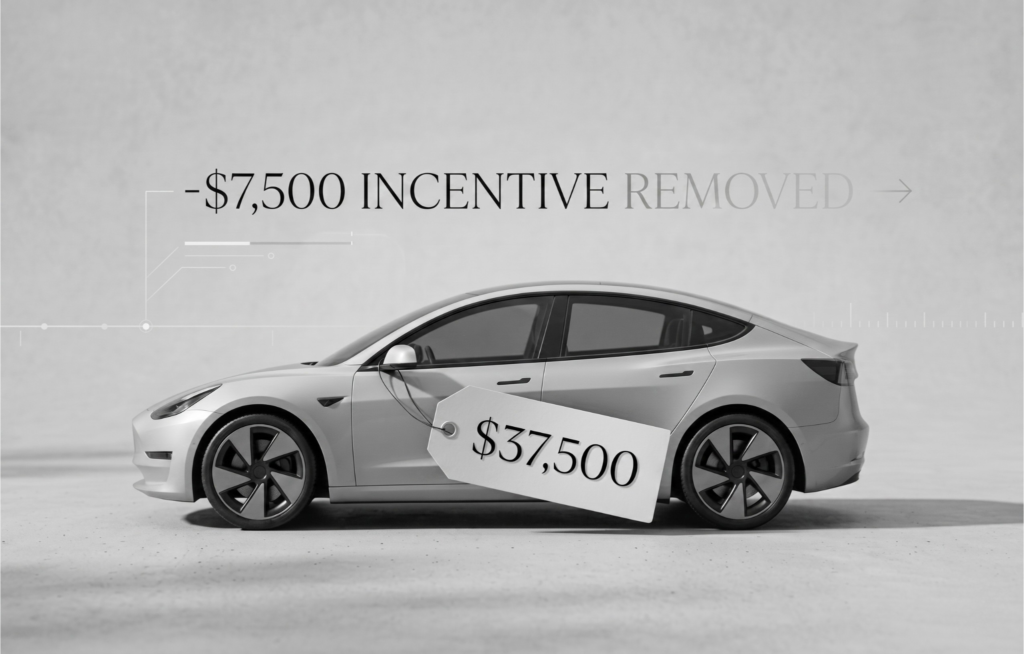
The federal EV tax credit ended on September 30, 2025. If you acquired a new or used electric vehicle after that date, no federal credit applies—and the effective purchase price of an EV rose by $4,000 to $7,500 overnight. For dealerships, that policy shift triggered one of the sharpest single-month demand swings in modern automotive history. Torkvia helps dealership groups navigate exactly this kind of market disruption—identifying high-intent buyers and adjusting strategy in real time as the landscape shifts beneath them.
The credits didn’t expire quietly. A Q3 buying surge followed by a Q4 freefall reshaped inventory levels, pricing strategy, and buyer expectations across the industry. Understanding the full picture of what ended, what didn’t, and what comes next is essential for dealers managing their EV business in 2026.
When Did the EV Tax Credit End?
The expiration date is September 30, 2025. The IRS confirmed that no clean vehicle credit is available for vehicles acquired after that date. This applies to new EVs (Section 30D), used EVs (Section 25E), and commercial EVs (Section 45W).
The credits were cut short by the One Big Beautiful Bill, signed into law on July 4, 2025. Under the original Inflation Reduction Act timeline, these credits were set to run through 2032—the legislation effectively cut seven years off the program.
What Credits Actually Expired
Three distinct federal EV credits expired simultaneously on September 30, 2025.
New EV Credit (Section 30D)
The Section 30D credit offered up to $7,500 for the purchase of a qualifying new electric vehicle. Eligibility was subject to vehicle MSRP caps, buyer income limits, and domestic manufacturing requirements introduced by the IRA in 2022.
Used EV Credit (Section 25E)
The Section 25E credit offered up to $4,000—or 30% of the sale price, whichever was lower—for qualifying previously-owned clean vehicles. The vehicle had to be at least two model years old and purchased from a licensed dealer.
Commercial EV Credit (Section 45W)
The Section 45W commercial credit applied to businesses purchasing EVs for commercial use, also expiring September 30, 2025. Fleet operators and businesses that had been relying on this credit to offset the higher upfront cost of commercial EVs lost the incentive simultaneously with individual buyers.
Can You Still Qualify After the Deadline?
Yes—under a specific condition. The IRS established a binding contract rule that allows buyers who completed certain steps before September 30 to still claim the credit even if the vehicle was delivered later.
The Binding Contract Loophole
To qualify after the deadline, a buyer must have entered into a written binding contract and made a payment on or before September 30, 2025. The IRS FAQ confirms that a nominal down payment is sufficient—the vehicle does not need to have been delivered by the deadline.
Purchase Date vs. Delivery Date
This distinction matters significantly for dealerships. “Acquired” is the operative IRS term, not “delivered” or “placed in service.” A buyer who signed a contract and paid a deposit in September 2025 but took delivery in November 2025 remains eligible for the credit. Dealers working through late-delivery situations should ensure buyers have documentation of both the binding contract and the payment date.
Why Did the EV Tax Credit End Early?
The IRA, signed in August 2022, extended clean vehicle credits through 2032 as part of a broad clean energy incentive package. The One Big Beautiful Bill—passed along party lines and signed July 4, 2025—restructured or eliminated most of those incentives years ahead of schedule.
EV credits were among the most prominent casualties. The political case for elimination centered on federal spending reduction and skepticism about whether subsidies were necessary to sustain EV demand. The market response in Q4 2025 provided a pointed answer.
Why EV Sales Spiked—Then Crashed
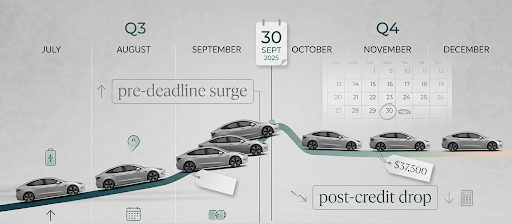
September 2025 was the highest-volume EV month on record. BEVs reached a 12% share of U.S. light-duty vehicle sales in September, as buyers rushed to beat the expiration. That surge created an artificial demand spike that immediately reversed once the deadline passed.
The Post-Credit Hangover
October 2025 told the full story. EV unit sales dropped 24% in a single month, and by November, BEVs had fallen to just 5.1% of new vehicle sales—down from 11.3% in September. Cox Automotive estimated Q4 EV sales at roughly 230,000 units, a 46% drop from Q3 and 37% decline year-over-year. New EV inventory also fell 33% year-over-year as automakers cut production ahead of the expected slowdown.
The Dealer Impact
Automakers responded by increasing incentives to compensate. J.D. Power estimated the average EV incentive reached $11,869 in November 2025 as manufacturers tried to offset the loss of federal credits. Despite that, new EVs sat on dealer lots an average of 91 days in Q4—the highest level in five years. The brands most dependent on the tax credit to move inventory faced the sharpest declines, while Tesla, with its lower price points, weathered the drop better than most competitors.
Not All EV Tax Credits Ended
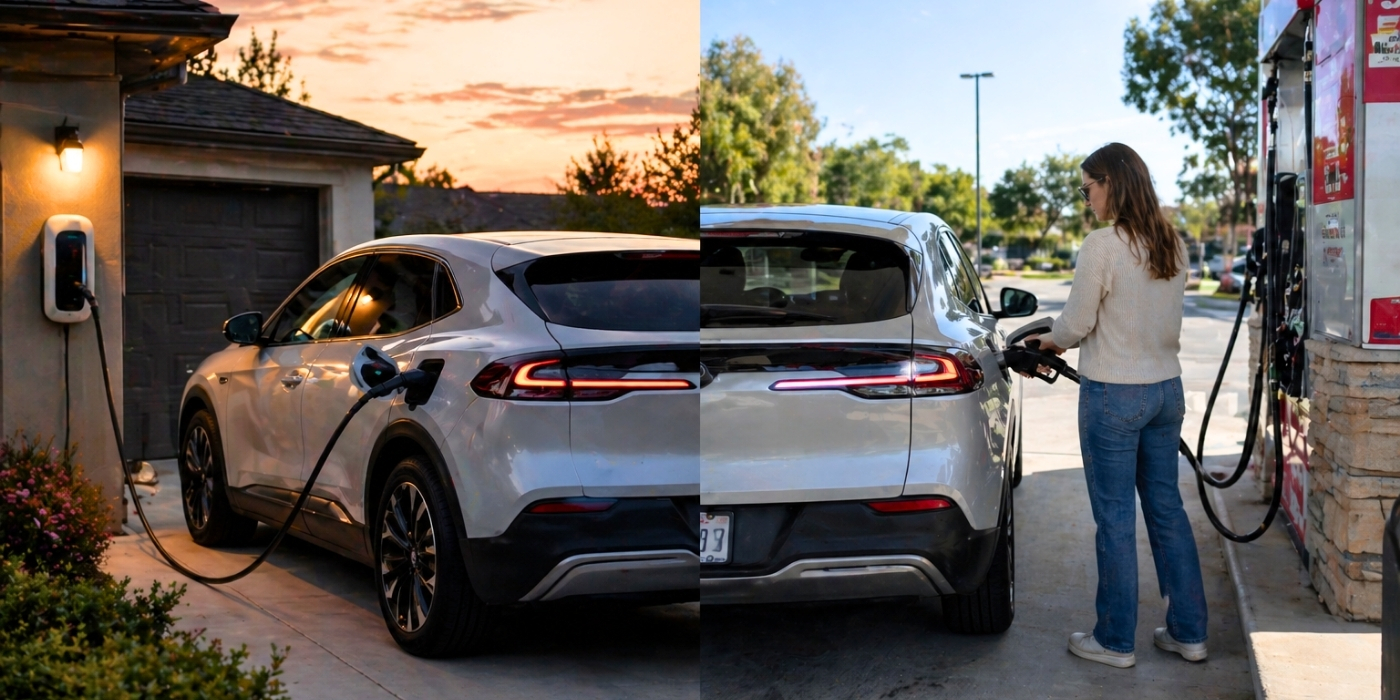
The vehicle purchase credits expired, but one EV-related federal incentive remains active. The Alternative Fuel Vehicle Refueling Property Credit (Section 30C) provides up to 30% of EV charger installation costs—capped at $1,000 for residential and $100,000 per port for commercial installations. It expires June 30, 2026.
Who Qualifies for the Charger Credit
Eligibility for the 30C credit is location-based, not income-based. The charger must be installed in a qualifying low-income or non-urban census tract. Most rural and many suburban areas qualify. The Kiplinger guide to 30C notes the credit is claimed via IRS Form 8911 at tax time—it does not transfer at the point of sale the way vehicle credits did.
A Window Closing Fast
For dealerships advising EV customers on total cost of ownership, the charger credit is a relevant piece of the conversation. A buyer installing a Level 2 home charger before June 30, 2026, in a qualifying location can still recover up to $1,000. That’s not $7,500, but it’s a legitimate savings point worth surfacing.
What Happens Now That the Credit Is Gone
The post-credit market is a reset, not a permanent collapse. Automakers are pricing more aggressively, hybrids are gaining share, and used EVs are drawing buyers who can’t justify new EV prices without the subsidy. Several states—including California, with its proposed $200 million replacement incentive program—are stepping in to fill the federal gap at the regional level.
Dealers who understand the full picture of what expired, what didn’t, and what state-level alternatives exist are better positioned to have honest, complete conversations with EV-curious buyers. That buyer education role is where dealerships can differentiate in a post-credit market. Torkvia helps dealership groups build the marketing infrastructure to reach those buyers, address their post-incentive concerns directly, and convert consideration into sales even in a more challenging demand environment.
Frequently Asked Questions
When exactly did the federal EV tax credit end?
The federal EV tax credit expired on September 30, 2025, for new, used, and commercial EVs. Any vehicle acquired after that date is not eligible for a federal clean vehicle credit. The credits were terminated early by the One Big Beautiful Bill, signed July 4, 2025, which cut short an incentive program originally set to run through 2032.
Can I still claim the EV tax credit if I ordered before September 30 but received delivery later?
Yes, if you signed a binding written contract and made a payment on or before September 30, 2025, you remain eligible for the credit even if the vehicle was delivered afterward. The IRS considers “acquisition date”—not delivery date—as the qualifying event. Keep your contract and proof of payment on file when you file your tax return.
How much was the EV tax credit worth before it expired?
The new EV credit (Section 30D) offered up to $7,500 for qualifying vehicles. The used EV credit (Section 25E) offered up to $4,000 or 30% of the sale price, whichever was lower. Both credits were nonrefundable, meaning they reduced federal tax liability dollar-for-dollar but could not produce a refund if the credit exceeded taxes owed.
Are there any federal EV incentives still available in 2026?
The vehicle purchase credits are gone, but the EV charger tax credit (Section 30C) remains active through June 30, 2026. It covers up to 30% of charger installation costs—capped at $1,000 for residential installations—for homes in qualifying low-income or non-urban census tracts. State-level incentives also vary widely; California, for example, is proposing a $200 million replacement program.
Why did EV sales drop so sharply after September 2025?
Demand collapsed because a large portion of EV buyers were directly incentivized by the $7,500 credit. Cox Automotive data showed Q4 2025 EV sales down 46% from Q3 as the pull-forward buying surge reversed. Some manufacturers saw month-over-month declines of 80–90% on specific models, confirming how dependent certain segments of EV demand had been on the federal subsidy.
Will EV tax credits come back?
That depends on future legislation, which is uncertain. The One Big Beautiful Bill passed on party-line votes, and any reinstatement would require a change in the political makeup of Congress or significant bipartisan support. In the near term, state-level programs are the more realistic source of new EV incentives, with California leading the effort to replace federal support with state funding.
Is buying an EV still worth it without the tax credit?
For many buyers, yes—particularly those with predictable high-mileage usage where fuel and maintenance savings offset the higher upfront cost over time. Without the credit, the break-even calculation takes longer, and the used EV market has become more attractive as off-lease vehicles from 2021–2023 enter inventory at significantly lower price points. The value case is still there; it just requires a longer time horizon.