If you’ve been following automotive news in 2026, you’ve probably noticed a new acronym showing up everywhere: EREV. Extended-range electric vehicles are suddenly the powertrain that every major automaker wants in their lineup. Ram, Ford, Jeep, Hyundai, Genesis, Scout, Kia, Nissan, and others have all announced EREV models, most targeting production between now and 2029.
The concept isn’t new. The Chevrolet Volt, BMW i3, and Fisker Karma all used range-extending architectures years ago. But those early attempts were niche products that never found a mass audience. What’s changed is the market context. Slowing BEV adoption, persistent charging infrastructure gaps, and consumer demand for vehicles that drive like EVs without the range anxiety have created conditions where the extended-range hybrid finally makes strategic sense at scale.
For consumers trying to make sense of yet another electrification option, and for dealer groups building inventory strategies around shifting powertrain demand, the EREV category deserves close attention. It sits at the intersection of what buyers say they want and what automakers can profitably build.
EREV vs. PHEV vs. BEV: Sorting Out the Differences
The alphabet soup of electrified powertrains can be genuinely confusing for consumers, and that confusion has real consequences for dealer groups trying to market these vehicles effectively. Here’s how the three main categories compare on the dimensions buyers care about most.
Driving experience. A BEV and an EREV feel nearly identical behind the wheel. Both deliver power exclusively through electric motors, with instant torque and smooth, linear acceleration. A PHEV feels different depending on mode. In electric-only mode it approximates the EV experience, but once the engine engages for propulsion, the character shifts. As EV.Guide notes, an EREV maintains the torque characteristics of a fully electric vehicle because the electric motors are connected directly to the drive wheels, just like in a BEV. Buyers who test-drive an EREV after driving a BEV will find the transition seamless. Buyers coming from a PHEV will notice the difference immediately.
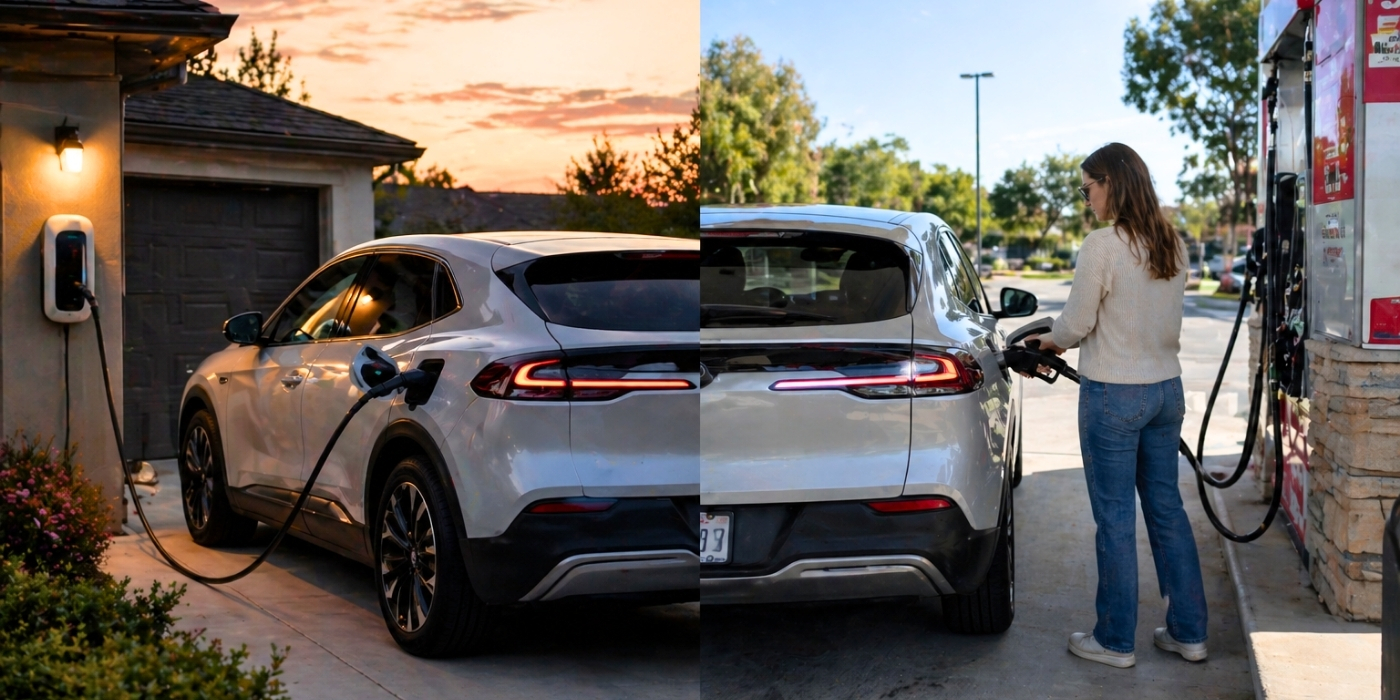
Range and refueling. BEVs offer 250 to 350 miles on a charge for most models, with refueling dependent on charging infrastructure. PHEVs offer 30 to 50 miles of electric range plus conventional gasoline range. EREVs offer 100 to 150 miles of electric range plus generator-extended range, with total figures reaching 500 to 700 miles. EREVs can be refueled at any gas station and recharged at any EV charger, giving them the broadest refueling flexibility of the three.
Cost. BEVs carry the highest upfront cost due to large battery packs. PHEVs are typically priced $3,000 to $8,000 above their ICE equivalents. EREV pricing is still emerging, but announced models like the Ram REV and Scout Harvester are targeting price points below their pure BEV counterparts. According to S&P Global Mobility’s James Martin, one key reason manufacturers are turning to EREVs is lower production costs, since smaller batteries reduce the most expensive component in the vehicle.
Emissions. A BEV produces zero tailpipe emissions. An EREV produces zero emissions when running on battery, and generator emissions when the engine is active. A PHEV’s emissions profile depends on how often the owner plugs in, a variable that has historically limited the environmental benefits of PHEVs since many owners treat them as conventional vehicles. EREVs, with their larger batteries and longer electric-only range, are more likely to cover the majority of daily driving on electricity alone.
Why Now? The Market Forces Behind the EREV Surge
The EREV’s moment has arrived because it solves problems that both consumers and automakers are struggling with simultaneously.
For consumers, the value proposition is straightforward. Range anxiety remains the single most cited barrier to BEV adoption in survey after survey. Public charging infrastructure in the U.S. has been slower to deploy than federal projections anticipated, and reliability at existing stations continues to frustrate owners.
EREVs sidestep the entire problem. When the battery runs out, the generator keeps the vehicle moving using gasoline from any gas station. Total range figures on announced EREV models are staggering: the Ram 1500 REV targets 690 miles, Ford’s next-generation F-150 Lightning EREV promises over 700, and Hyundai is projecting more than 560 miles for its upcoming EREV SUVs. These numbers eliminate range as a purchasing objection entirely.
For automakers, the economics are compelling. EREVs use smaller, less expensive batteries than full BEVs, which keeps production costs down. They’re also less mechanically complex than traditional plug-in hybrids, which require two fully functioning propulsion systems with sophisticated controls to manage the interaction between them. An EREV’s gasoline engine can be simpler and smaller than what a PHEV requires because it never needs to produce the torque and power characteristics necessary to physically drive the wheels. It just needs to spin a generator efficiently. The BMW i3’s range extender, for example, used a modified motorcycle engine. The upcoming Nissan Rogue e-Power is expected to use a small turbocharged three-cylinder.
The China Factor: A Preview of Where This Goes
The story of EREVs can’t be told without looking at China, where the technology has already been tested at scale.
Li Auto, the Chinese automaker largely credited with popularizing EREVs, built its entire brand around the architecture. The company’s L-series SUVs proved that families wanted the EV experience for daily driving but the security of a gasoline backup for longer trips.
Between 2021 and 2024, Chinese EREV sales grew by 218%, 130%, 154%, and 70.9% year over year, with market share climbing from 3.6% to 9.1%. That’s a remarkable growth trajectory. But the Chinese market also offers a cautionary note: EREV sales in China declined for three consecutive months in mid-2025 as pure BEV range exceeded 500 km on new models, fast-charging infrastructure expanded rapidly, and battery costs were projected by Goldman Sachs to reach $99 per kWh in 2025. 400 miles seems to be the point of range equilibrium that tips the scales in favour of BEVs.
The lesson for the U.S. market is nuanced. EREVs thrive in environments where charging infrastructure is incomplete and BEV range creates anxiety. That describes the American market in 2026 accurately, but it won’t describe the American market forever. As charging networks mature and battery costs continue declining, the EREV’s core advantage narrows. The technology is likely a bridge, but it could be a very, very long bridge, especially for trucks and large SUVs where battery weight, cost, and towing-range penalties make pure BEV solutions challenging for years to come.
The Models Coming to Market
The wave of EREV product announcements in 2025 and 2026 is concentrated in the truck and large SUV segments, where the technology’s advantages are most pronounced. Large vehicles have the physical space to accommodate both a meaningful battery pack and a generator, and they serve buyer demographics where range, towing capability, and refueling convenience are non-negotiable.
The Ram 1500 REV is expected to be among the first next-generation EREVs to reach U.S. showrooms, scheduled for production in the second half of 2026 as a 2027 model. It pairs a 92 kWh battery with a 3.6-liter V6 generator and dual electric motors producing 647 horsepower. With a 29-gallon fuel tank, total range reaches approximately 690 miles, with around 145 miles of battery-only driving.
Stellantis is applying the same architecture to the Jeep Grand Wagoneer, which may arrive as early as 2026 and targets more than 500 miles of total range using the same 92 kWh battery and dual-motor setup.
Ford has confirmed that the next-generation F-150 Lightning will shift from a pure BEV to an EREV architecture, with a projected range exceeding 700 miles. Detailed specifications remain scarce, but the move signals Ford’s recognition that electric truck buyers, particularly those who tow, need range flexibility that current battery technology alone can’t deliver affordably.
Scout Motors, the Volkswagen-backed brand, will offer its Traveler SUV and Terra pickup with an EREV option called “Harvester.” Scout CEO Scott Keogh has indicated that roughly 85% of reservation holders prefer the EREV configuration over the pure electric version, a data point that speaks volumes about where consumer preference sits in this segment.
Hyundai plans to begin U.S. production of EREV models by late 2026, with sales beginning in early 2027. Both Hyundai and Genesis will offer EREV SUVs targeting over 560 miles of combined range. Kia confirmed at its April 2026 CEO Investor Day that a Telluride EREV is in development, expected by 2029.
Nissan’s approach is slightly different. The upcoming Rogue e-Power uses a series hybrid architecture similar to EREVs but with a smaller battery, targeting fuel economy competitive with the RAV4 Hybrid and CR-V Hybrid rather than the 500-plus-mile range figures of the truck-focused EREVs. It represents the compact crossover application of the same underlying principle: electric motors drive the wheels, gasoline engines generate electricity.
Is your group’s powertrain strategy keeping pace with how the EREV category is reshaping buyer expectations? Torkvia helps automotive groups build inventory and visibility marketing strategies that align with emerging demand signals, not yesterday’s segment definitions. Talk to Torkvia →
What This Means for Dealer Groups
The EREV wave creates both a near-term sales opportunity and a longer-term strategic question for dealer groups.
On the immediate side, these vehicles solve the two biggest objections that walk-in customers raise against EVs: range and charging. A salesperson can point to a 690-mile total range figure and a gas tank that works at every station in America. That’s a fundamentally easier conversation than explaining public charging networks, home charger installation, and route planning apps. EREVs will likely convert a segment of buyers who were interested in electrification but unwilling to commit to a BEV. They’re the “yes, and” answer to the EV pitch.
The marketing and search visibility challenge is more subtle. Consumers searching for information about EREVs are using a wide range of terminology: “extended range hybrid,” “range extender EV,” “series hybrid,” “EREV,” and model-specific queries like “Ram Ramcharger range.” Dealer groups that build content and search strategies around this fragmented keyword landscape early will capture demand that competitors haven’t positioned for yet. The category is new enough that search competition is relatively low, making it an ideal window for content investment.
Service departments should also prepare. EREVs combine EV drivetrain components (high-voltage batteries, electric motors, power electronics) with ICE components (engine, fuel system, exhaust). Technicians will need competence across both domains. The training and tooling investment sits somewhere between what a PHEV requires and what a pure BEV demands.
The strategic question is whether EREVs become a permanent category or a transitional one. History suggests the latter. But the transition could last a decade or more in the truck and SUV segments, which means dealer groups have time to build expertise, capture market share, and develop customer relationships in a powertrain category with strong margins and genuine consumer enthusiasm.
Frequently Asked Questions
What is the difference between an EREV and a plug-in hybrid?
In an EREV, the gasoline engine never drives the wheels directly. It only generates electricity to recharge the battery or power the electric motors. In a PHEV, both the engine and motor can drive the wheels together or independently. EREVs feel like EVs all the time. PHEVs feel like EVs in electric mode and like conventional cars when the engine engages for propulsion.
Is an EREV better than an EV?
Neither is categorically better. BEVs offer zero tailpipe emissions and lower operating costs for owners with reliable charging access. EREVs offer comparable driving dynamics with the added security of gasoline backup, making them better suited for buyers with long commutes, towing needs, or limited charging infrastructure. The right choice depends on individual driving patterns and infrastructure access.
What extended-range hybrids are coming to the U.S.?
Confirmed EREV models heading to the U.S. market include the Ram 1500 REV, Jeep Grand Wagoneer EREV, Ford F-150 Lightning EREV, Scout Traveler and Terra Harvester, Hyundai and Genesis EREV SUVs, Nissan Rogue e-Power, and a Kia Telluride EREV. Most are targeting production between 2026 and 2029, with the Ram and Jeep models expected first.
How far can an extended-range hybrid drive?
Total range varies by model, but announced figures are significantly higher than any current BEV. The Ram 1500 REV targets 690 miles, the Ford F-150 Lightning EREV projects over 700, and Hyundai’s EREV SUVs aim for more than 560. Electric-only range typically falls between 100 and 150 miles, with the gasoline generator extending range by 400 to 550 additional miles.
Do EREVs qualify for the federal EV tax credit?
Eligibility depends on the specific model’s battery capacity and domestic content compliance under the Inflation Reduction Act. Most EREVs with battery packs above 7 kWh will meet the minimum battery threshold, but full credit eligibility also requires domestic assembly and battery component sourcing requirements. Buyers should verify eligibility on a model-by-model basis as vehicles reach market.
The powertrain landscape is fragmenting faster than most dealer groups can track.
Torkvia helps automotive groups build search visibility and market positioning across every electrification category, from hybrids to EREVs to full BEVs.Talk to Torkvia →