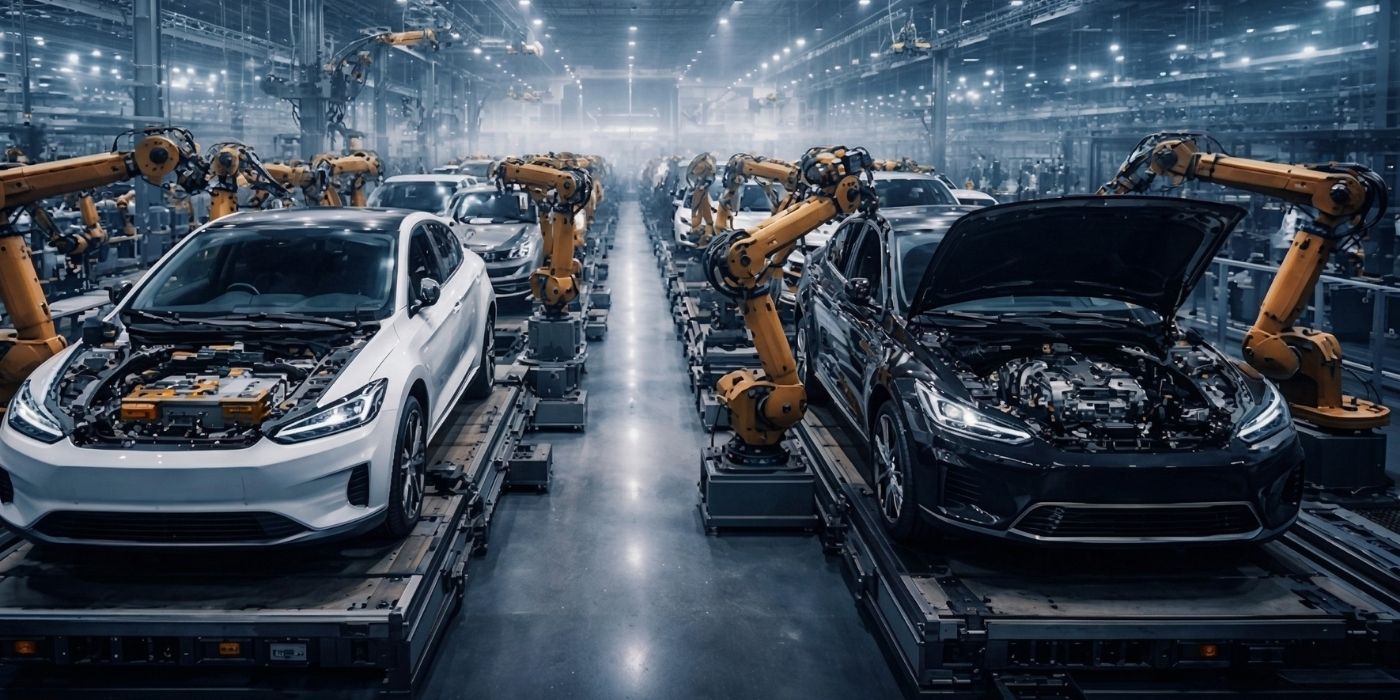
The biggest automotive investment story of the past five years just reversed course. By early 2026, the industry had absorbed at least $65 billion in EV writedowns — Stellantis booking $26 billion, Ford taking a $19.5 billion charge, and GM absorbing $7.6 billion — as automakers walked back the all-electric strategies they announced with fanfare just years before. The EV slowdown isn’t just an industry story — it’s a reallocation of billions in marketing spend toward what consumers are actually searching for right now.
Torkvia helps automotive groups navigate exactly these kinds of structural market changes — turning industry-wide disruption into dealership-level competitive advantage through AI-powered marketing and data-driven advertising.
This Isn’t a Slow Pivot — It’s a $70 Billion Reset
From 2021 to 2024, automakers announced over $330 billion in EV and battery investments, driven by policy mandates and early adoption enthusiasm. The correction has been swift. Global carmakers have now booked over $55 billion in EV-related hits as they scale back electrification plans — a figure that climbs past $70 billion when Honda and other international manufacturers are included.
According to ABC News, EV market share in the U.S. collapsed from a record 12% in September 2025 — just before the $7,500 federal tax credit expired — to just 6% by January 2026. Mark Wakefield of AlixPartners told ABC News that while analysts had forecast a drop-off, “the size of the write-offs took people by surprise.”
Why EV Demand Collapsed
The expiration of federal EV tax credits on September 30, 2025 was the single largest demand trigger. EV sales in the U.S. plunged 20% in January 2026 versus December 2025, according to Cox Automotive data. The Trump administration compounded the shift by rolling back Biden-era fuel economy standards — reducing the required average mpg from 50.4 to 34.5 — and rescinding rules that incentivized EV production to meet fuel economy requirements.
Policy changes removed the regulatory pressure that had been pushing automakers toward EVs regardless of market demand. Without mandates or consumer incentives, the gap between EV production costs and what buyers were willing to pay became impossible to bridge at scale.
The Production Consequences
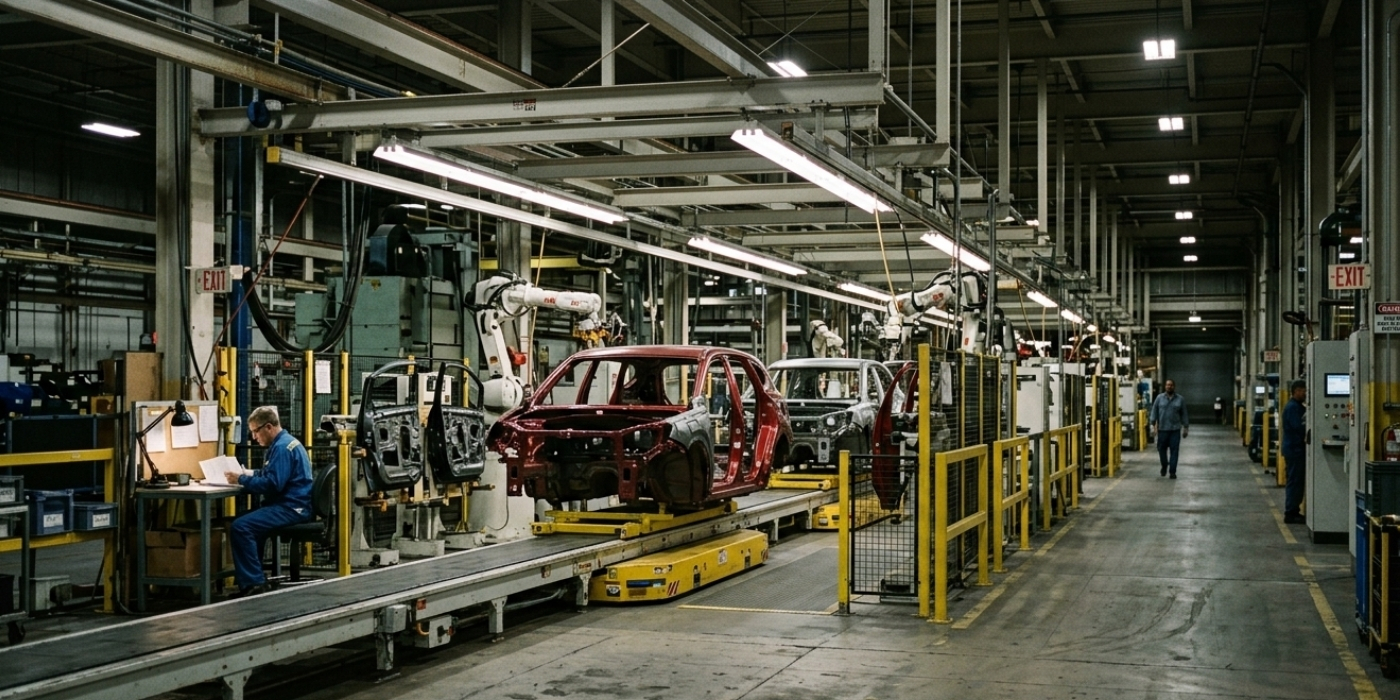
The financial writedowns have translated directly into manufacturing changes. GM cut over 1,200 jobs at its EV plant in Detroit and has reduced production of the Cadillac Lyriq, GMC Hummer EV, and Cadillac Escalade IQ. Business Insider reported approximately 1,750 layoffs across GM’s EV divisions, with EV demand slowdown and the regulatory environment cited as the primary drivers.
Automakers are also canceling models entirely. Volvo canceled the EX30 and Honda dropped the Prologue, while Stellantis shelved the Ram 1500 REV all-electric pickup and the Dodge Charger Daytona SRT Banshee. Even luxury brands are restructuring: Bentley announced hundreds of UK job cuts amid a pivot toward hybrids as EV demand softens across segments.

Where the Money Is Going Instead
When automakers pull $70 billion out of EVs, they don’t just change production — they change what gets marketed, what gets searched, and what actually sells. The reallocation is already happening across three distinct areas.
Hybrids Are the New Growth Story
The EIA confirmed that hybrid electric vehicle sales continued rising in 2025 even as BEV sales fell — the first year on record where annual BEV sales declined. S&P Global Mobility data shows hybrid registrations jumped from 3.1% of new vehicle sales in Q2 2020 to 16.3% by Q2 2025, nearly double the EV share of 8.6% over the same period.
Dealership Guy, citing Bloomberg, reports that while fully electric vehicles made up 10% of U.S. auto sales in Q3 2025, hybrids accounted for 15% over the same period. CarGurus predicts nearly one in six new vehicles sold in 2026 will be a hybrid. The fastest-selling vehicle in all of 2025 was the Hyundai Palisade Hybrid, moving off dealer lots in under 14 days on average.
ICE Is Profitable Again — and Getting Investment
Ford’s pivot is the clearest signal of where capital is flowing. The company is converting its Tennessee EV factory to produce gas-powered pickup trucks and targeting 50% hybrid and EV combined production by 2030 — with hybrids as the primary growth driver. Ford CEO Jim Farley noted that hybrid F-150 sales now represent 30% of the model’s total business, with November 2025 hybrid sales up 30% while overall sales remained flat.
GM is redirecting unused EV plant capacity toward increased ICE production, and Stellantis is reintroducing the Hemi V8 — a powertrain it had previously discontinued — as part of its brand recovery strategy. Short-term profitability is driving investment back toward proven products.
Used EVs Are Creating a New Market Segment
As new EV demand weakens, falling prices are steering U.S. buyers toward used electric vehicles. Used hybrid listings are up 11% year-over-year according to GreenCars. This creates a distinct market segment — buyers who want electrification at an affordable price point — that requires its own marketing approach, separate from both new EV and new hybrid campaigns.
What This Means for Dealership Marketing Budgets Right Now
The OEM-level budget reallocation flows directly to dealerships through co-op spending, inventory mix, and demand signals. The Alliance for Automotive Innovation’s Q1 2025 EV report confirmed hybrid market share grew 4.3 percentage points year-over-year while ICE share contracted — the clearest signal of where buyer demand is concentrating. The category now dominating electrified sales has historically received a fraction of the marketing investment that EVs commanded.
Digital Dealer’s 2026 Auto Shopper report found that 33% of prospective buyers are targeting hybrids versus only 16% targeting full EVs — yet most dealership marketing still reflects the prior EV-first era. That gap is the opportunity.
Shift Messaging From Future-First to Value-Now
EV campaigns were built around aspiration, sustainability narratives, and technology storytelling. That content is now misaligned with buyer psychology. Ansira’s report notes the marketing opportunity has shifted to “affordability, reliability, and consumer choice.”
Dealership content, landing pages, and ad copy should lead with fuel savings, total cost of ownership, and monthly payment comparisons rather than environmental positioning. The buyer has changed — the messaging needs to follow.
Reallocate From Brand Awareness to Performance Channels
With hybrids and ICE vehicles, buyers already know what they want. The marketing job shifts from education to conversion — meaning paid search, local SEO, inventory-based advertising, and retargeting deliver better ROI than the awareness-heavy channel mix that dominated EV budgets.
Build SEO Around the Keyword Shift
Search demand has already moved. “Best hybrid SUVs 2026,” “hybrid vs gas cost comparison,” and “used EV under $30,000” are high-intent queries with rising volume and relatively low competition — because most automotive content is still optimized for the EV-first era. Dealerships that build content around these clusters now will own those rankings before competition catches up.
Torkvia Helps Dealerships Capture the Reallocation
The OEM budget reset creates a narrow window where dealerships that move first — with the right inventory positioning, messaging, and channel mix — capture disproportionate market share before the broader industry catches up. Most dealership groups lack the internal resources to execute that kind of rapid strategic pivot across content, paid media, and SEO simultaneously.
Torkvia’s AI-powered marketing platform identifies emerging buyer intent, realigns campaign messaging to match current demand signals, and executes across channels at the speed market shifts require. Torkvia has delivered 27% more appointments, 26% higher conversion rates, and 24% increases in repurchase rates for automotive groups that moved from reactive to proactive marketing. Contact Torkvia to position your dealership on the right side of the $70 billion reset.
The Reallocation Is Already Happening — Are You in Front of It?
When automakers pull billions from EV budgets, they aren’t abandoning electrification — they’re correcting the timeline. Cox Automotive’s Stephanie Valdez Streaty put it plainly to ABC News: “The future is electric. However, the timeline is being recalibrated.” For dealerships, that recalibration means the marketing priorities of 2023 and 2024 no longer match what buyers are searching for in 2026.
The dealers who win this transition aren’t the ones who bet heaviest on EVs — they’re the ones who recognized the shift first and moved their marketing to match it.
Frequently Asked Questions
How much have automakers actually written down in EV investments?
By early 2026, the industry had collectively absorbed over $65 billion in EV-related writedowns and losses, according to industry analysis. Stellantis alone recorded $26 billion, Ford took a $19.5 billion charge, and GM absorbed $7.6 billion — with additional losses from Honda and other international manufacturers pushing the total past $70 billion.
Are EVs dead, or is this a temporary slowdown?
This is a timeline correction, not an abandonment. Cox Automotive describes 2026 as a year the industry is “trying to find natural demand,” and PwC forecasts EVs will reach 19% of the U.S. market by 2030. The shift is away from mandate-driven adoption and toward consumer-driven demand — which means the pace slows, but the direction doesn’t reverse.
Why are hybrids winning where EVs stalled?
Hybrids offer fuel efficiency without range anxiety, require no charging infrastructure, and are now priced comparably to equivalent gas models. S&P Global Mobility data shows hybrid registrations nearly doubled EV registrations by mid-2025. The Hyundai Palisade Hybrid was the fastest-selling vehicle of 2025, averaging fewer than 14 days on dealer lots.
What marketing channels should dealerships prioritize now?
Performance channels — paid search, local SEO, and inventory-based advertising — deliver better ROI than the awareness-heavy mix that dominated EV campaigns. Buyers for hybrids and ICE vehicles already know what they want; the marketing job is conversion, not education.
What keywords should dealership SEO target in 2026?
High-intent queries with rising volume include “best hybrid SUVs 2026,” “hybrid vs gas cost comparison,” “most fuel-efficient cars,” and “used EV under $30,000.” Most automotive SEO is still optimized for the prior EV era, creating a window to capture rankings before competition increases.
How does the used EV market factor into dealership strategy?
Falling new EV prices have made used EVs increasingly attractive to budget-conscious buyers. Used hybrid listings are up 11% year-over-year, and this segment requires distinct marketing — affordability-focused messaging targeting buyers who want electrification without the new-vehicle price premium.
How should dealership ad copy change given the EV pullback?
Messaging should shift from sustainability and technology narratives toward fuel savings, total ownership cost, and monthly payment comparisons. Ansira’s 2026 Automotive Trends report identifies affordability and reliability as the dominant purchase motivators for today’s automotive buyer — and ad copy that leads with those attributes will outperform EV-era creative in conversion rate.