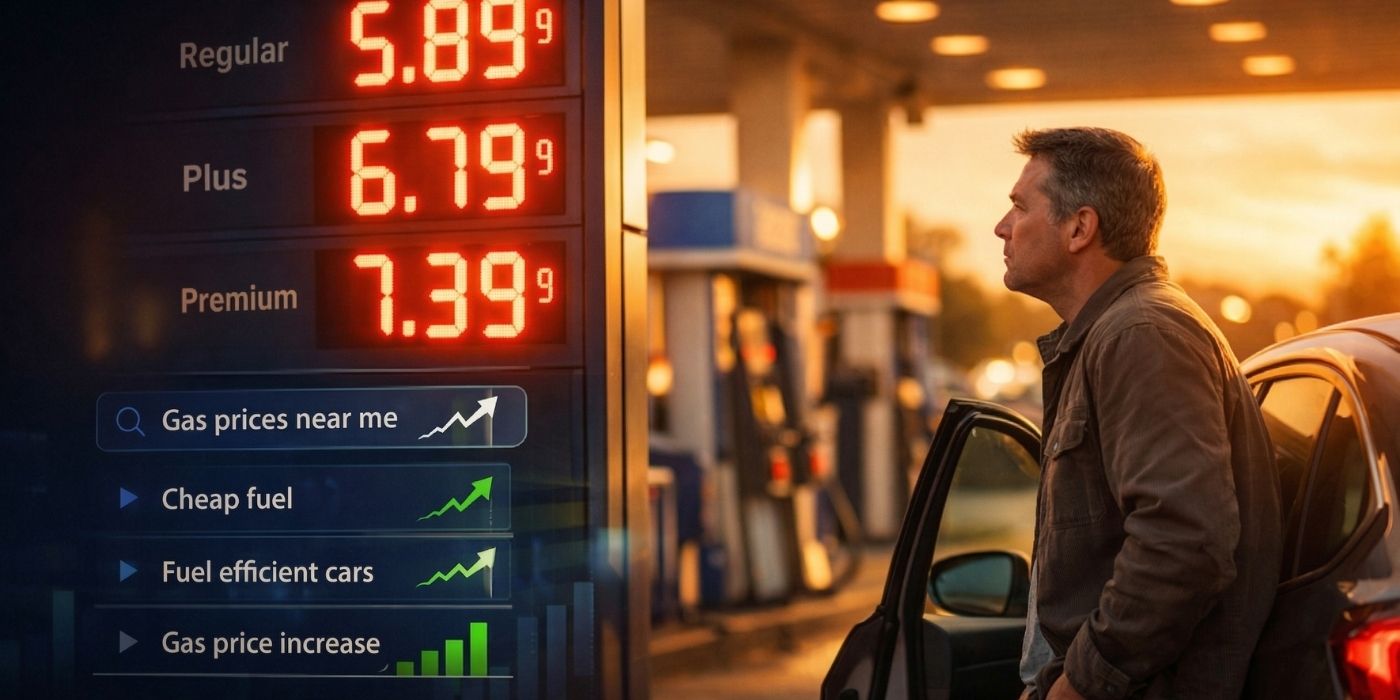
Gas prices didn’t inch upward over the past month — they surged. The national average climbed to $3.91 per gallon by March 20, with three states now above $5, after holding below $3 for 13 straight weeks before March. That kind of move doesn’t just strain household budgets — it reshapes what buyers are searching for, in real time, right now.
For dealerships evaluating their automotive SEO strategy right now, the timing couldn’t be more consequential. Torkvia helps dealership groups respond to exactly these kinds of market disruptions using AI-powered marketing platforms and data-driven advertising that tracks intent as it shifts.
This Was a Trigger Event — Not a Trend
According to Reuters, U.S. gasoline prices climbed more than 30% since the U.S. and Israel attacked Iran at the end of February. As Business Insider reported, Iran responded by attacking Ras Laffan Industrial City — home to the world’s largest LNG export plant, accounting for nearly one-fifth of global LNG trade. According to The Guardian, QatarEnergy confirmed the strikes damaged 17% of its LNG export capacity, with repairs expected to take three to five years. A single infrastructure event didn’t create a trend. It created a shock.
The Numbers Behind the Shock
Fortune’s real-time oil tracker shows Brent crude at $107.40 per barrel on March 20, up from $72 one month prior — a 49% increase in under 30 days. Business Insider reported Brent surged as high as $119 at the peak of the attacks. According to the U.S. Energy Information Administration, crude oil accounts for approximately 51% of the retail price of gasoline — so when oil moves this fast, pump prices follow immediately.
According to Investopedia, prices rose 93 cents in 20 days, with forecasters at Pantheon Macroeconomics projecting the national average will hit $4.20 in the coming days. State prices now range from $3.26 in Oklahoma to $5.66 in California — a $2.40 spread that creates significant geo-targeting opportunity for dealers, which we’ll return to below.
What Actually Drives Gas Prices — And Why It Matters for SEO
University of Colorado Boulder finance professor Edward Van Wesep explains that even the world’s largest oil producers can’t insulate domestic consumers from global supply disruptions — the price of oil is set by the world market. The Guardian reports that Wood Mackenzie concluded the Qatar attacks fundamentally altered the global gas market outlook, with each additional month of disruption removing roughly 1.5% from annual global LNG availability.
This matters for SEO because it explains why consumer intent shifted so fast. The Guardian also cites RSM UK chief economist Thomas Pugh warning that sustained high energy prices could push inflation toward 5%, making rate hikes more likely — and as economist Joe Lavorgna noted on CNBC, nothing erodes household liquidity faster than higher gas prices. That economic pressure shows up immediately in searches like “should I buy a car now” and “car affordability 2026.”
Car Dealership SEO During a Gas Price Spike: What’s Different
Dealership SEO operates differently from general content marketing during a price shock. Inventory is live, lot composition is fixed in the short term, and the gap between what’s on the lot and what buyers are searching widens fast. Historical data from iSeeCars shows that for every dollar increase in average gas prices, monthly pickup truck sales drop roughly 2%. The pattern is consistent: Axios, citing Edmunds data, found that during the 2008 price spike, compact car sales as a share of new vehicle purchases jumped from roughly 20% to 56% in months.
Dealers whose SEO reflects last quarter’s inventory mix are already pointing buyers toward the wrong pages.
The SEO Window Most Automotive Brands Missed
A Wharton School analysis of U.S. gas price trends found that Google search interest for fuel-related terms spikes sharply the moment prices move — with “gas” and “oil” searches mirroring each other closely during sudden price events. Most automotive SEO strategies are built on static keyword sets and quarterly content calendars. When a shock event reshapes consumer intent in under three weeks, those strategies are already behind before anyone notices.
Gas prices jumped 93 cents in 20 days. That’s the gap between when intent shifts and when the content ecosystem catches up. Dealerships that publish relevant content during that window capture rankings before competitors react — those who wait are chasing positions others already own.
New Keyword Demand This Spike Is Generating
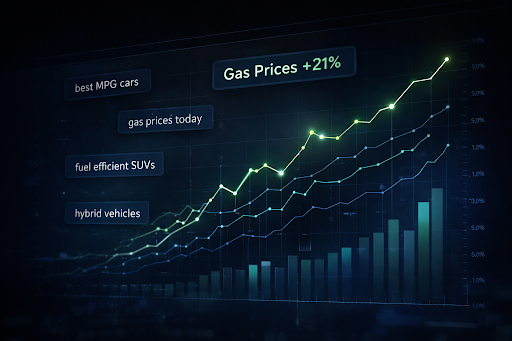
EBSCO’s research on gasoline pricing confirms that geopolitical price shocks have historically triggered immediate reconsideration of large purchases. For automotive SEO, that means identifiable keyword clusters emerge fast — and the dealers who target them first win the rankings.
Immediate-Intent Keywords to Target Now
Queries now surging include “fuel efficient cars 2026,” “best MPG SUV,” “hybrid vs gas savings,” and “cars with lowest fuel cost per mile.” These are live opportunities with a short window before competition catches up and ranking difficulty increases.
Rising-Intent and Local Keywords to Build Now
Al Jazeera reports that analysts are now seriously considering $150–$200 per barrel oil scenarios. That uncertainty generates forward-looking queries — “best cars if gas hits $5,” “EV vs hybrid cost comparison 2026” — that don’t carry high volume yet but will. Meanwhile, the $2.40 state price spread makes local intent queries like “best fuel-efficient cars in [city]” and “hybrid dealership near me” a geo-targeting opportunity most national competitors won’t pursue.
How Automotive SEO Should Pivot Right Now
A gas price shock doesn’t require rebuilding an entire strategy — it requires fast, targeted execution across a few high-leverage surfaces within the 7–21 day window.
Update Inventory Page Metadata and Copy
Pages optimized for power, towing, or cargo are now misaligned with buyer intent. Updating title tags, meta descriptions, and above-the-fold copy to lead with MPG and total ownership cost takes hours — and immediately realigns relevance with active search demand.
Publish Rapid-Response Content
Three to five targeted posts — “Best Fuel-Efficient SUVs for 2026,” “Hybrid vs Gas: What the Current Spike Changes,” “Is Now a Good Time to Buy a Car?” — place the dealership’s domain inside high-velocity queries quickly. They don’t need to be long. They need to be relevant, published within the window, and internally linked to relevant inventory.
Adjust Paid Messaging and Refresh Internal Links
Ad copy emphasizing performance is currently misaligned with buyer psychology under fuel pressure. Shifting to “lowest cost of ownership” and “fuel savings over five years” messaging converts better when gas is top-of-mind. Simultaneously, a fast internal linking audit — pointing homepage banners and popular content toward efficient vehicle categories — amplifies existing inventory without new content investment.
Build Geo-Targeted Pages for Local Price Variation
The $2.40 spread between cheapest and most expensive states means local search intent is highly specific right now. Geo-targeted landing pages built around “best fuel-efficient cars in [city]” capture queries that national competitors won’t touch — and they build lasting local SEO equity beyond the immediate spike.
Torkvia Turns Market Shifts Into SEO Action
Most dealership groups lack the internal resources to execute a rapid content pivot, realign paid messaging, and update metadata across dozens of inventory pages within the critical window. That’s exactly where Torkvia operates — monitoring shifting buyer intent, identifying emerging keyword clusters before volume peaks, and executing changes at the speed market events demand.
Torkvia has delivered 27% more appointments, 26% higher conversion rates, and 24% increases in repurchase rates for automotive groups that moved from reactive to proactive marketing strategies. Contact Torkvia to build an SEO strategy that adapts when the market does.
When the Market Moves, Strategy Has to Move With It
Oil prices don’t rise on a schedule — they spike in response to events. The buyers your dealership needs to reach are already recalibrating what they want before the ink dries on the headlines. The dealers who win aren’t the ones who had the best strategy six weeks ago. They’re the ones who updated it last week.
When oil markets move, search behavior moves with them — instantly. The problem is, most automotive SEO strategies don’t.
Frequently Asked Questions
New Keyword Demand This Spike Is Generating
EBSCO’s research on gasoline pricing confirms that geopolitical price shocks have historically triggered immediate reconsideration of large purchases. For automotive SEO, that means identifiable keyword clusters emerge fast — and the dealers who target them first win the rankings.
Immediate-Intent Keywords to Target Now
Queries now surging include “fuel efficient cars 2026,” “best MPG SUV,” “hybrid vs gas savings,” and “cars with lowest fuel cost per mile.” These are live opportunities with a short window before competition catches up and ranking difficulty increases.
Rising-Intent and Local Keywords to Build Now
Al Jazeera reports that analysts are now seriously considering $150–$200 per barrel oil scenarios. That uncertainty generates forward-looking queries — “best cars if gas hits $5,” “EV vs hybrid cost comparison 2026” — that don’t carry high volume yet but will. Meanwhile, the $2.40 state price spread makes local intent queries like “best fuel-efficient cars in [city]” and “hybrid dealership near me” a geo-targeting opportunity most national competitors won’t pursue.
How Automotive SEO Should Pivot Right Now
A gas price shock doesn’t require rebuilding an entire strategy — it requires fast, targeted execution across a few high-leverage surfaces within the 7–21 day window.
Update Inventory Page Metadata and Copy
Pages optimized for power, towing, or cargo are now misaligned with buyer intent. Updating title tags, meta descriptions, and above-the-fold copy to lead with MPG and total ownership cost takes hours — and immediately realigns relevance with active search demand.
Publish Rapid-Response Content
Three to five targeted posts — “Best Fuel-Efficient SUVs for 2026,” “Hybrid vs Gas: What the Current Spike Changes,” “Is Now a Good Time to Buy a Car?” — place the dealership’s domain inside high-velocity queries quickly. They don’t need to be long. They need to be relevant, published within the window, and internally linked to relevant inventory.
Adjust Paid Messaging and Refresh Internal Links
Ad copy emphasizing performance is currently misaligned with buyer psychology under fuel pressure. Shifting to “lowest cost of ownership” and “fuel savings over five years” messaging converts better when gas is top-of-mind. Simultaneously, a fast internal linking audit — pointing homepage banners and popular content toward efficient vehicle categories — amplifies existing inventory without new content investment.
Build Geo-Targeted Pages for Local Price Variation
The $2.40 spread between cheapest and most expensive states means local search intent is highly specific right now. Geo-targeted landing pages built around “best fuel-efficient cars in [city]” capture queries that national competitors won’t touch — and they build lasting local SEO equity beyond the immediate spike.
Torkvia Turns Market Shifts Into SEO Action
Most dealership groups lack the internal resources to execute a rapid content pivot, realign paid messaging, and update metadata across dozens of inventory pages within the critical window. That’s exactly where Torkvia operates — monitoring shifting buyer intent, identifying emerging keyword clusters before volume peaks, and executing changes at the speed market events demand.
Torkvia has delivered 27% more appointments, 26% higher conversion rates, and 24% increases in repurchase rates for automotive groups that moved from reactive to proactive marketing strategies. Contact Torkvia to build an SEO strategy that adapts when the market does.
When the Market Moves, Strategy Has to Move With It
Oil prices don’t rise on a schedule — they spike in response to events. The buyers your dealership needs to reach are already recalibrating what they want before the ink dries on the headlines. The dealers who win aren’t the ones who had the best strategy six weeks ago. They’re the ones who updated it last week.
When oil markets move, search behavior moves with them — instantly. The problem is, most automotive SEO strategies don’t.
Frequently Asked Questions
How quickly do gas price spikes affect automotive search behavior?
Search interest for fuel-related terms spikes almost immediately when gas prices move sharply, according to Wharton School research on U.S. gas price trends. Consumers don’t wait for prices to stabilize — they start researching alternatives within days of a noticeable pump price increase.
Which vehicle categories see the biggest SEO impact during a gas price spike?
Hybrid vehicles, compact cars, and fuel-efficient SUVs see the sharpest uptick in search demand. According to iSeeCars, pickup truck sales drop roughly 2% for every dollar increase in average gas prices — and that behavioral shift shows up in search before it appears in sales figures.
What specific SEO changes should a dealership make right now?
The highest-impact moves are updating inventory page metadata to emphasize MPG and fuel cost, publishing rapid-response content targeting efficiency queries, and aligning paid search copy with cost-of-ownership messaging. An internal linking audit pointing to fuel-efficient inventory is also a quick win that requires no new content.
Does a gas price spike accelerate EV interest?
Yes — significantly. When gas hit $4.25 per gallon in 2022, it triggered the highest recorded level of EV consumer interest at that time. Price shocks push buyers already on the fence toward EV and hybrid consideration, making that content a high-value SEO target during these periods.
New Keyword Demand This Spike Is Generating
EBSCO’s research on gasoline pricing confirms that geopolitical price shocks have historically triggered immediate reconsideration of large purchases. For automotive SEO, that means identifiable keyword clusters emerge fast — and the dealers who target them first win the rankings.
Immediate-Intent Keywords to Target Now
Queries now surging include “fuel efficient cars 2026,” “best MPG SUV,” “hybrid vs gas savings,” and “cars with lowest fuel cost per mile.” These are live opportunities with a short window before competition catches up and ranking difficulty increases.
Rising-Intent and Local Keywords to Build Now
Al Jazeera reports that analysts are now seriously considering $150–$200 per barrel oil scenarios. That uncertainty generates forward-looking queries — “best cars if gas hits $5,” “EV vs hybrid cost comparison 2026” — that don’t carry high volume yet but will. Meanwhile, the $2.40 state price spread makes local intent queries like “best fuel-efficient cars in [city]” and “hybrid dealership near me” a geo-targeting opportunity most national competitors won’t pursue.
How Automotive SEO Should Pivot Right Now
A gas price shock doesn’t require rebuilding an entire strategy — it requires fast, targeted execution across a few high-leverage surfaces within the 7–21 day window.
Update Inventory Page Metadata and Copy
Pages optimized for power, towing, or cargo are now misaligned with buyer intent. Updating title tags, meta descriptions, and above-the-fold copy to lead with MPG and total ownership cost takes hours — and immediately realigns relevance with active search demand.
Publish Rapid-Response Content
Three to five targeted posts — “Best Fuel-Efficient SUVs for 2026,” “Hybrid vs Gas: What the Current Spike Changes,” “Is Now a Good Time to Buy a Car?” — place the dealership’s domain inside high-velocity queries quickly. They don’t need to be long. They need to be relevant, published within the window, and internally linked to relevant inventory.
Adjust Paid Messaging and Refresh Internal Links
Ad copy emphasizing performance is currently misaligned with buyer psychology under fuel pressure. Shifting to “lowest cost of ownership” and “fuel savings over five years” messaging converts better when gas is top-of-mind. Simultaneously, a fast internal linking audit — pointing homepage banners and popular content toward efficient vehicle categories — amplifies existing inventory without new content investment.
Build Geo-Targeted Pages for Local Price Variation
The $2.40 spread between cheapest and most expensive states means local search intent is highly specific right now. Geo-targeted landing pages built around “best fuel-efficient cars in [city]” capture queries that national competitors won’t touch — and they build lasting local SEO equity beyond the immediate spike.
Torkvia Turns Market Shifts Into SEO Action
Most dealership groups lack the internal resources to execute a rapid content pivot, realign paid messaging, and update metadata across dozens of inventory pages within the critical window. That’s exactly where Torkvia operates — monitoring shifting buyer intent, identifying emerging keyword clusters before volume peaks, and executing changes at the speed market events demand.
Torkvia has delivered 27% more appointments, 26% higher conversion rates, and 24% increases in repurchase rates for automotive groups that moved from reactive to proactive marketing strategies. Contact Torkvia to build an SEO strategy that adapts when the market does.
When the Market Moves, Strategy Has to Move With It
Oil prices don’t rise on a schedule — they spike in response to events. The buyers your dealership needs to reach are already recalibrating what they want before the ink dries on the headlines. The dealers who win aren’t the ones who had the best strategy six weeks ago. They’re the ones who updated it last week.
When oil markets move, search behavior moves with them — instantly. The problem is, most automotive SEO strategies don’t.
Frequently Asked Questions
How quickly do gas price spikes affect automotive search behavior?
Search interest for fuel-related terms spikes almost immediately when gas prices move sharply, according to Wharton School research on U.S. gas price trends. Consumers don’t wait for prices to stabilize — they start researching alternatives within days of a noticeable pump price increase.
Which vehicle categories see the biggest SEO impact during a gas price spike?
Hybrid vehicles, compact cars, and fuel-efficient SUVs see the sharpest uptick in search demand. According to iSeeCars, pickup truck sales drop roughly 2% for every dollar increase in average gas prices — and that behavioral shift shows up in search before it appears in sales figures.
What specific SEO changes should a dealership make right now?
The highest-impact moves are updating inventory page metadata to emphasize MPG and fuel cost, publishing rapid-response content targeting efficiency queries, and aligning paid search copy with cost-of-ownership messaging. An internal linking audit pointing to fuel-efficient inventory is also a quick win that requires no new content.
Does a gas price spike accelerate EV interest?
Yes — significantly. When gas hit $4.25 per gallon in 2022, it triggered the highest recorded level of EV consumer interest at that time. Price shocks push buyers already on the fence toward EV and hybrid consideration, making that content a high-value SEO target during these periods.
How long does the SEO opportunity window last after a gas price spike?
Typically 7 to 21 days from the initial event. That’s the period when consumer intent has shifted but the content ecosystem hasn’t caught up — early movers capture rankings before competitors respond, as the 93-cent jump in 20 days illustrates clearly.
Will higher gas prices slow car buying overall?
Price shocks can delay large purchases for some buyers, but they also accelerate trade-in decisions for drivers moving out of less efficient vehicles. The opportunity is highly category-dependent — and dealers whose SEO reflects that nuance will capture both sides of the shift.
What happens to automotive SEO if oil climbs toward $150–$200 per barrel?
At those levels, fuel efficiency becomes a primary purchase driver rather than a secondary consideration, according to analysts cited by Al Jazeera. Content built around cost-per-mile, total ownership cost, and EV adoption becomes essential rather than supplemental for any competitive automotive SEO strategy.
Typically 7 to 21 days from the initial event. That’s the period when consumer intent has shifted but the content ecosystem hasn’t caught up — early movers capture rankings before competitors respond, as the 93-cent jump in 20 days illustrates clearly.
Will higher gas prices slow car buying overall?
Price shocks can delay large purchases for some buyers, but they also accelerate trade-in decisions for drivers moving out of less efficient vehicles. The opportunity is highly category-dependent — and dealers whose SEO reflects that nuance will capture both sides of the shift.
What happens to automotive SEO if oil climbs toward $150–$200 per barrel?
At those levels, fuel efficiency becomes a primary purchase driver rather than a secondary consideration, according to analysts cited by Al Jazeera. Content built around cost-per-mile, total ownership cost, and EV adoption becomes essential rather than supplemental for any competitive automotive SEO strategy.
Search interest for fuel-related terms spikes almost immediately when gas prices move sharply, according to Wharton School research on U.S. gas price trends. Consumers don’t wait for prices to stabilize — they start researching alternatives within days of a noticeable pump price increase.
Which vehicle categories see the biggest SEO impact during a gas price spike?
Hybrid vehicles, compact cars, and fuel-efficient SUVs see the sharpest uptick in search demand. According to iSeeCars, pickup truck sales drop roughly 2% for every dollar increase in average gas prices — and that behavioral shift shows up in search before it appears in sales figures.
What specific SEO changes should a dealership make right now?
The highest-impact moves are updating inventory page metadata to emphasize MPG and fuel cost, publishing rapid-response content targeting efficiency queries, and aligning paid search copy with cost-of-ownership messaging. An internal linking audit pointing to fuel-efficient inventory is also a quick win that requires no new content.
Does a gas price spike accelerate EV interest?
Yes — significantly. When gas hit $4.25 per gallon in 2022, it triggered the highest recorded level of EV consumer interest at that time. Price shocks push buyers already on the fence toward EV and hybrid consideration, making that content a high-value SEO target during these periods.
How long does the SEO opportunity window last after a gas price spike?
Typically 7 to 21 days from the initial event. That’s the period when consumer intent has shifted but the content ecosystem hasn’t caught up — early movers capture rankings before competitors respond, as the 93-cent jump in 20 days illustrates clearly.
Will higher gas prices slow car buying overall?
Price shocks can delay large purchases for some buyers, but they also accelerate trade-in decisions for drivers moving out of less efficient vehicles. The opportunity is highly category-dependent — and dealers whose SEO reflects that nuance will capture both sides of the shift.
What happens to automotive SEO if oil climbs toward $150–$200 per barrel?
At those levels, fuel efficiency becomes a primary purchase driver rather than a secondary consideration, according to analysts cited by Al Jazeera. Content built around cost-per-mile, total ownership cost, and EV adoption becomes essential rather than supplemental for any competitive automotive SEO strategy.